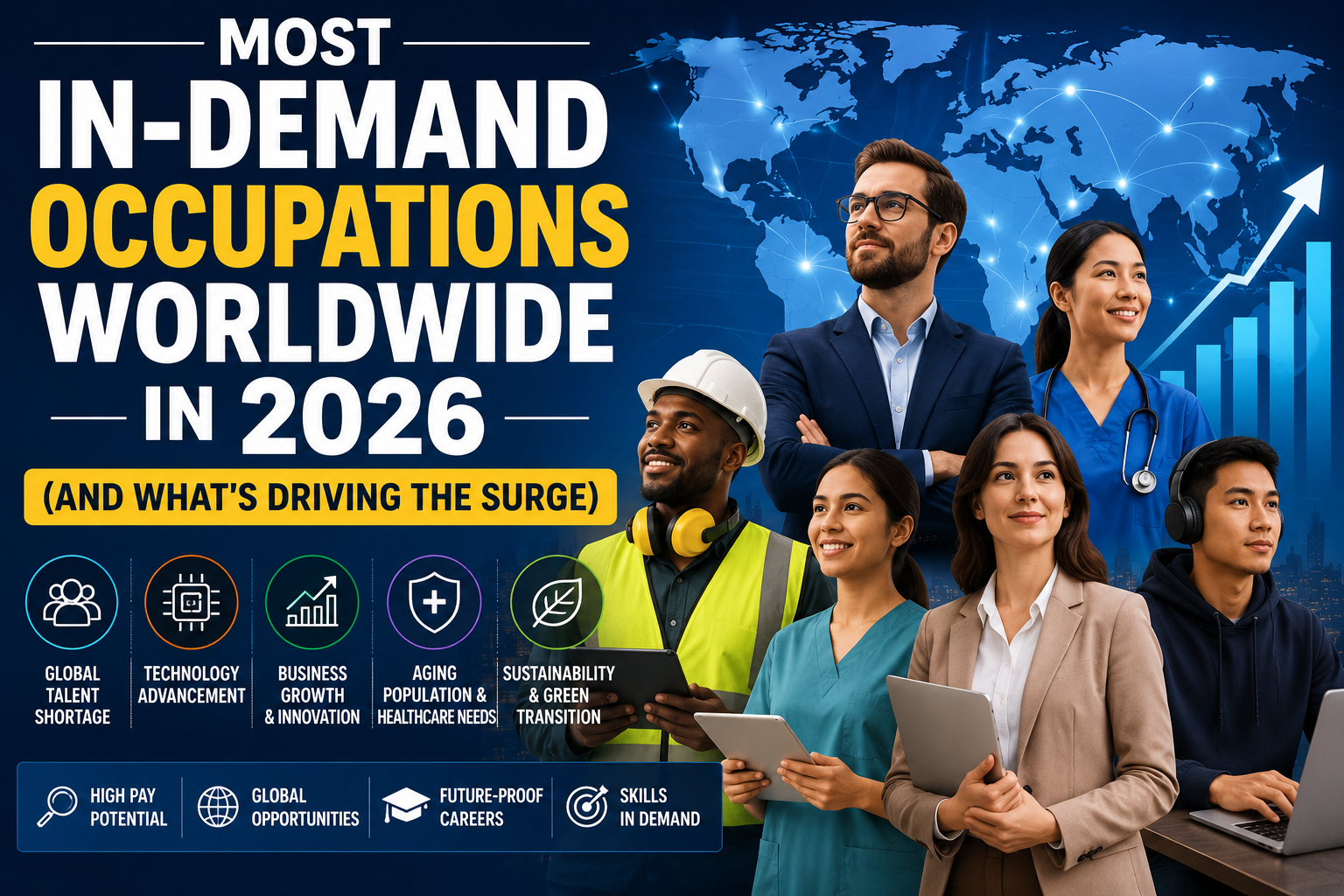
The global job market has never moved this fast. Roles that barely existed five years ago are now among the most sought-after positions on the planet, while careers that once felt bulletproof are quietly shrinking. Whether you’re a fresh graduate mapping out a career path, a professional thinking about switching lanes, or simply someone trying to understand where the world of work is headed — this breakdown is for you.
Here’s what the data actually says about the most in-demand occupations worldwide right now, and why these specific roles are pulling ahead of the pack.
The Big Picture First
Before we get into individual roles, it’s worth zooming out. The World Economic Forum’s Future of Jobs Report 2025 projects that by 2030, 170 million new jobs will be created while 92 million will be displaced — a net increase of 78 million jobs globally. That sounds like good news, and it mostly is, but the catch is significant: nearly 40% of skills required on the job are set to change, and 63% of employers already cite the skills gap as the key barrier they face in transforming their businesses.
In plain terms, there’s no shortage of work. There’s a shortage of people who can do the work that actually needs doing right now.
ManpowerGroup reports that 74% of employers worldwide struggle to find the skilled workers they need — the highest proportion in 18 years. That number alone tells you everything about the current landscape. Demand is high, supply is low, and the gap is widening faster than training systems can fill it.
So which jobs sit at the center of that gap? Let’s get into it.
1. Software Engineers and Developers
This one hasn’t moved from the top spot in years, and with good reason. Software engineer, nurse, and salesperson remained the three most in-demand jobs overall based on global LinkedIn data through mid-2025. Software engineers top the list because nearly every industry — from banking to agriculture to healthcare — now runs on code. The demand isn’t just from tech companies anymore. It’s universal.
Specializations in cloud computing, mobile development, and API integrations are particularly hot. If you’re in this field and haven’t touched cloud infrastructure yet, that’s your next move.
2. AI and Machine Learning Specialists
This is the category that’s rewriting everything else on this list. The WEF identifies AI and Big Data specialists as the fastest-growing role category globally, projecting a 94% demand increase by 2030. That’s not a gradual climb — that’s an explosion.
What’s interesting is that AI roles aren’t just for people with PhDs in computer science anymore. A newer category — sometimes called AI prompt engineers or AI workflow specialists — has emerged for professionals who can build reliable prompts, test outputs, reduce errors, and help organizations use AI tools safely and efficiently. The barrier to entry is lower than most people think, and the demand is real.
LinkedIn analysis of upskilling trends shows that the proportion of workers with AI skills has increased by at least 100% across all sectors since 2016, yet demand for these skills is still accelerating far more quickly than global supply.
3. Cybersecurity Professionals
The more digital the world becomes, the more vulnerable it is. Cybercrime caused an estimated $10.5 trillion in damage worldwide in 2025, and the profession of information security analyst is projected to see 29% growth in jobs by 2034. That’s one of the fastest growth trajectories of any occupation currently being tracked.
Organizations across government, finance, healthcare, and retail are scrambling to hire people who can protect their systems, data, and customers. The supply of qualified cybersecurity professionals is nowhere near demand levels, which means salaries in this field remain aggressively competitive.
4. Registered Nurses and Healthcare Workers
Healthcare is the other dominant force shaping global labor demand, and it’s not slowing down. Aging populations across North America, Europe, and East Asia are driving sustained, structural demand for nurses, physicians, physiotherapists, and allied health workers.
The BLS projects that healthcare occupations will dominate the fastest-growing jobs list in the US, with 6.7 million new jobs expected between 2023 and 2033. This pattern holds internationally. Germany currently lists more shortage occupations than at any point in its modern history, and a significant chunk of those shortages are in healthcare.
Beyond clinical roles, health informatics — the intersection of healthcare and data — is becoming its own high-demand specialty as hospitals and clinics digitize their operations.
5. Data Analysts and Data Scientists
We live in an era of data abundance and insight scarcity. Companies are generating more information than ever before, but turning that information into decisions that actually move the needle requires people who know what they’re doing. Data science specialists have seen rising demand as AI continues to reshape businesses, leading to aggressive recruiting for top-tier analytical talent.
The role spans industries. A data analyst at a retail company is doing fundamentally similar work to one at a hospital or a government agency — pulling data, finding patterns, translating findings into something leadership can act on. The core skills are transferable, which makes this one of the more flexible career paths on this list.
6. Renewable Energy Technicians
This is the career category most people underestimate. The global shift away from fossil fuels isn’t just an environmental story — it’s a massive employment story. IRENA reports 16.2 million renewable energy jobs worldwide, up 18% in three years, and the IEA projects that clean energy employment will reach 35 million globally by 2030.
Wind turbine technicians and solar panel installers are among the fastest-growing specific occupations in several major economies. Electric vehicle manufacturing, battery technology, grid modernization, and green building are all generating sustained demand that didn’t meaningfully exist a decade ago. The number of job postings requiring at least one green skill has risen by nearly 22% in just one year, yet talent supply is still catching up.
If you’re considering a technical trade, this is where the long-term wind is blowing.
7. Project Managers
Not every high-demand job is technical. Project management has proven remarkably resilient to automation because it’s fundamentally about coordinating people, timelines, and competing priorities — things that software still handles poorly. Project management ranks among the top five career fields for work-from-anywhere jobs globally, alongside computer and IT, marketing, and communications.
With PMP certification consistently ranking among the most recognized professional credentials globally, this is a career path with clear entry points and strong return on investment for the time spent qualifying.
8. Sales Professionals
This one surprises some people, but sales is perennially one of the world’s most in-demand occupations because no business survives without revenue. The role has evolved significantly — modern sales professionals are expected to be consultative, data-informed, and comfortable with CRM platforms and digital outreach tools — but the human core of the job, building trust and communicating value, remains stubbornly automation-resistant.
Salespeople in SaaS, medical devices, financial services, and enterprise technology are particularly sought after right now.
The Skills That Cut Across Everything
Beyond specific job titles, employers worldwide are increasingly hiring for a core set of human capabilities that complement technical skills. Analytical thinking is the most in-demand skill, with about 69% of employers saying it is a core requirement for their workforce. Resilience, flexibility, and agility ranks second, with two-thirds of employers calling these essential.
AI and big data skills top the list of fastest-growing technical capabilities, followed by networks and cybersecurity and technological literacy. Creative thinking and resilience, along with curiosity and lifelong learning, are also rising rapidly in importance.
The pattern is consistent: employers want people who can think, adapt, and keep learning — not just people who know today’s tools, because today’s tools will look different in three years.
What This Means for You
The global job market in 2026 rewards people who sit at intersections. A nurse who understands health data systems. A developer who can work with AI models. A project manager with cybersecurity awareness. The specialists who can bridge disciplines are the ones getting the most competitive offers.
In 2026, professionals who invest in upskilling and adapt to changing market needs have a clear advantage. That’s not motivational-poster language — it’s what the data consistently shows. The fastest-moving careers right now belong to people who treat their skills as a living document, not a finished product.
The opportunities are genuinely there. The question is whether you’re positioning yourself to reach them.
Have thoughts on which careers are rising in your region? Drop a comment below — the job market looks different depending on where you’re sitting, and those local nuances matter.