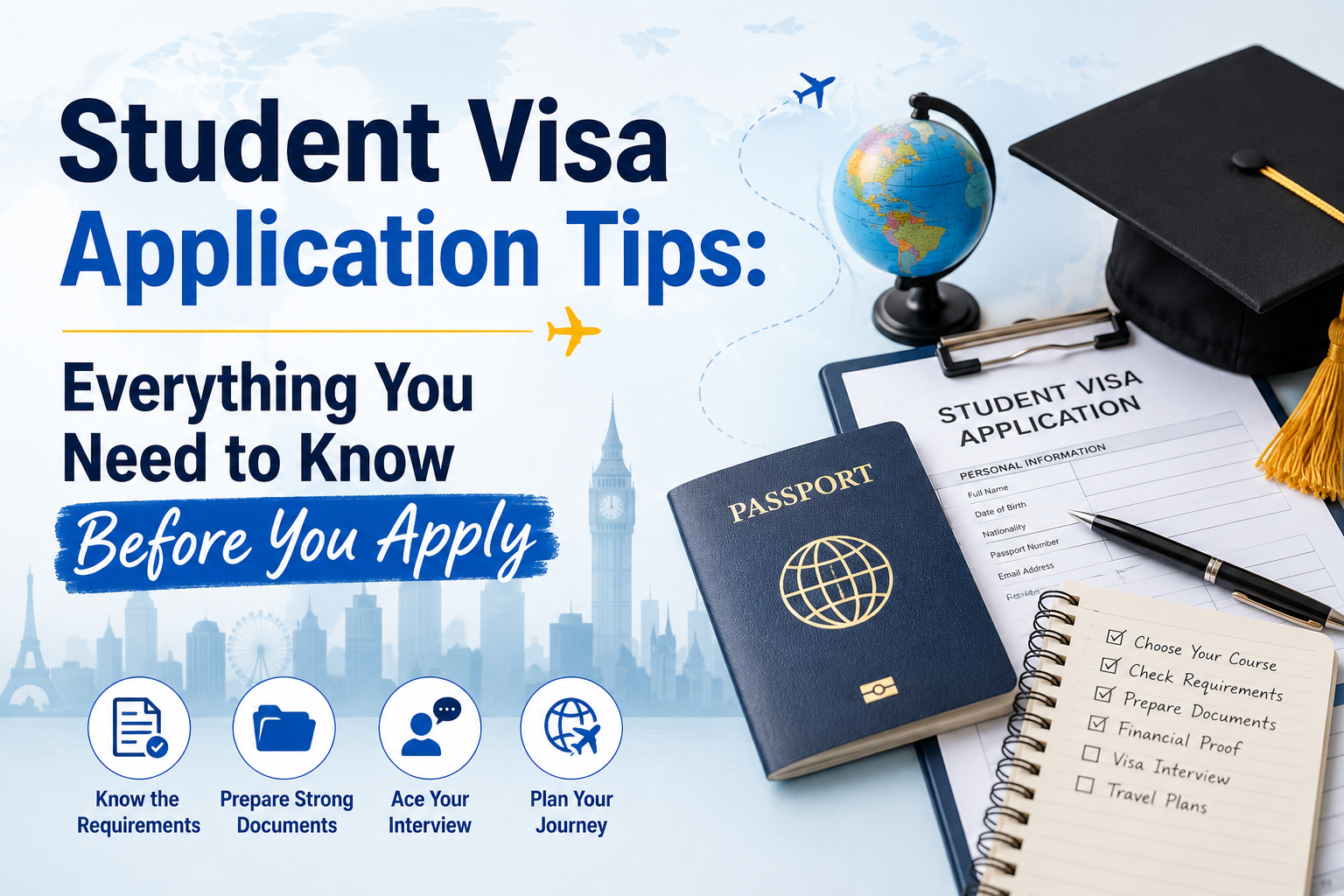
In this comprehensive guide, we’ll walk you through the most important student visa application tips, common mistakes to avoid, and proven strategies to boost your chances of approval.
What Is a Student Visa and Why Does It Matter?
A student visa is an official government-issued document that allows foreign nationals to reside in a country for the purpose of pursuing education. Without it, you cannot legally enroll in a program, open a local bank account, or even access on-campus accommodation in most countries.
Different countries have different visa categories. The United States issues the F-1 visa, the United Kingdom grants the Student Visa (formerly Tier 4), Canada offers the Study Permit, and Australia issues the Student Visa (subclass 500). Each has its own requirements, processing times, and eligibility criteria — so the first step is understanding exactly which visa applies to your destination.
Tip 1: Start the Application Process Early
This is the single most important piece of advice for any international student. Many applicants underestimate how long the visa process takes. Depending on your destination country and your home country’s diplomatic relationship with it, processing times can range from two weeks to several months.
Experts recommend beginning your visa application at least three to six months before your intended start date. This gives you enough buffer time to:
- Gather all required documents
- Schedule and complete required medical examinations
- Attend biometrics appointments
- Handle any unexpected delays or requests for additional information
Starting early is not just practical — it also demonstrates seriousness and organization to the visa officer reviewing your case.
Tip 2: Understand the Specific Requirements for Your Destination Country
Every country has its own unique set of requirements. A mistake many applicants make is assuming the process is the same everywhere. It isn’t. Before you fill out a single form, visit the official government immigration website of your destination country and read the requirements carefully.
Here are some common documents most student visa applications require:
- A valid passport (usually valid for at least six months beyond your stay)
- Letter of acceptance from a recognized institution
- Proof of financial support (bank statements, scholarship letters, or sponsor affidavits)
- Academic transcripts and certificates
- Language proficiency test results (IELTS, TOEFL, Duolingo, etc.)
- Passport-sized photographs meeting specific formatting requirements
- Completed visa application form
- Visa application fee payment receipt
- Medical certificates or health insurance (for select countries)
- Biometrics data (fingerprints and photographs)
Always cross-check the official checklist — missing even one document can delay or derail your application entirely.
Tip 3: Prepare a Convincing Statement of Purpose
Your Statement of Purpose (SOP), also called a personal statement or study plan, is your opportunity to tell the visa officer — and the admissions committee — why you want to study abroad, what you plan to study, and how it aligns with your future career goals.
A strong SOP should:
- Clearly explain your academic background and why you chose your specific field
- Highlight why you selected that particular university and country
- Demonstrate your intention to return home after your studies (this is especially important for visa purposes)
- Be written in clear, grammatically correct English
- Avoid generic, copied templates that sound robotic
Visa officers are trained to detect fabricated or overly generic statements. Be authentic, specific, and structured in your writing.
Tip 4: Prove Your Financial Capability Convincingly
One of the most common reasons student visa applications get rejected is insufficient proof of financial support. Immigration authorities need to be confident that you can fund your tuition, accommodation, and daily living expenses without becoming a financial burden on the host country.
Financial documents you may need include:
- Recent bank statements (usually covering the last three to six months)
- Fixed deposit certificates
- Scholarship award letters with detailed funding information
- Sponsorship letters from parents or guardians, along with their employment records and income statements
The key is not just to show the money exists, but to demonstrate that it has been consistently available. Sudden large deposits just before the application can raise red flags with immigration officers.
Tip 5: Be Honest and Consistent in All Your Documents
Consistency is absolutely critical. Every document you submit must align with every other document. The name on your passport must match the name on your acceptance letter. The dates in your transcripts must make logical sense alongside your statement of purpose. Your financial records must be coherent with the lifestyle and tuition level you’re describing.
Any inconsistencies — even minor ones — can trigger further scrutiny or outright rejection. Never submit altered or falsified documents. Immigration fraud can result in permanent bans from re-applying, and in some cases, criminal charges.
Tip 6: Prepare Thoroughly for the Visa Interview
Not all student visa processes require an interview, but those that do — such as the US F-1 visa — place significant weight on how you present yourself to the consular officer. The interview is often short (sometimes just five to ten minutes), but it can determine the outcome of months of preparation.
Practical interview tips:
- Know your acceptance letter details — which program, which university, start date, duration
- Be clear about your funding sources — who is sponsoring you and how
- Demonstrate strong ties to your home country — family, property, employment after graduation
- Dress professionally and arrive early
- Answer questions directly and honestly — avoid over-explaining
- Do not memorize scripted answers — speak naturally and confidently
The golden rule: convince the officer that you are a genuine student who will return home after completing your studies.
Tip 7: Don’t Overlook Health Insurance and Medical Requirements
Several countries — including Australia, the UK, and Canada — require international students to have valid health insurance coverage. Australia, for instance, mandates Overseas Student Health Cover (OSHC) as a visa requirement. The UK charges an Immigration Health Surcharge (IHS) as part of the online application.
Some countries also require medical examinations before visa approval, particularly if you’re coming from a country with high rates of certain communicable diseases. Book your medical appointment early, as results can take time to be submitted to immigration authorities.
Tip 8: Track Your Application and Follow Up Appropriately
Once you’ve submitted your application, it can be difficult to just sit and wait. Most immigration portals allow you to track your application status online. Check it regularly and respond promptly to any requests for additional information or documentation.
If your processing time has exceeded the stated window, it is appropriate to follow up through the official embassy or high commission contact channels. Be polite, concise, and professional in all communications.
Common Reasons Student Visa Applications Get Rejected
Understanding why visas get rejected helps you avoid those pitfalls:
- Incomplete or incorrect documentation
- Insufficient financial proof
- Weak ties to home country — raising concern the applicant will overstay
- Poor academic track record with no explanation
- Inconsistencies between submitted documents
- Failure to demonstrate genuine study intent
- Criminal background (varies by country)
If your visa is rejected, most countries allow you to reapply or appeal. Take the refusal notice seriously — it will indicate the reasons — and address each issue thoroughly before reapplying.
Final Thoughts: Preparation Is Your Greatest Advantage
A student visa application is not something to rush or take lightly. Every detail matters — from the clarity of your personal statement to the consistency of your bank statements. The students who succeed are not necessarily the wealthiest or the most academically accomplished. They are the ones who are best prepared.
Do your research, gather your documents early, be honest in everything you submit, and present yourself as the genuine, ambitious student you are. With the right approach, your student visa will be the first step — not an obstacle — on your journey to achieving your academic dreams.